
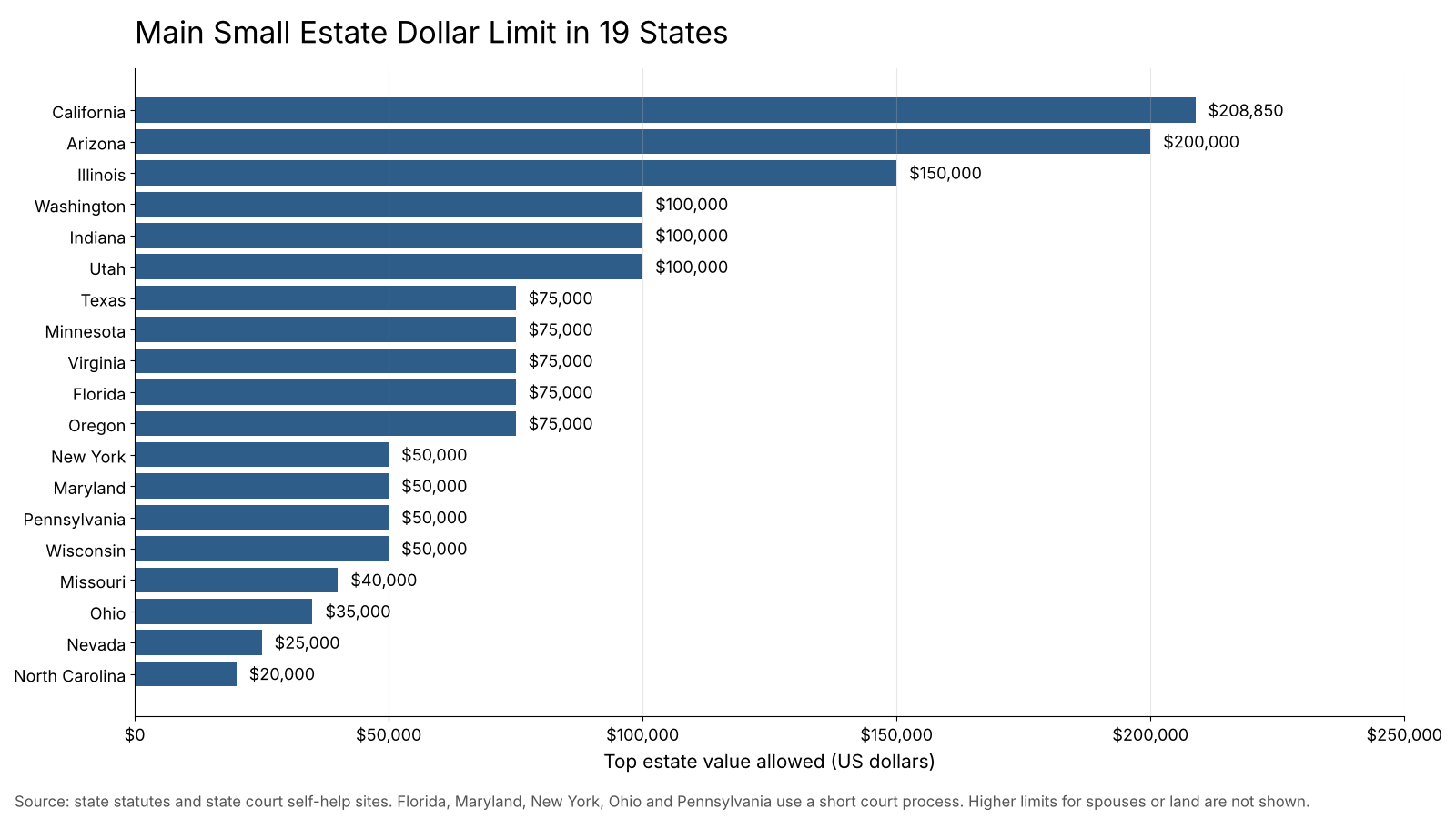
A small estate affidavit is a sworn form that lets heirs collect what a loved one left without a full probate case. The main test is size: in California, for example, an estate worth $208,850 or less qualifies when the death was on or after April 1 of last year, while Missouri caps the same shortcut at $40,000. So whether you can use one depends on the state where the person lived.
Every state sets its own limit, its own waiting period and its own list of what the form can reach. Texas makes heirs wait 30 days after the death, for instance, whereas Virginia asks them to wait at least 60 days. In addition, some states count only personal property, such as bank accounts and cars, and leave the house out of the math.
The papers also land in different places. In Minnesota, the signed form goes straight to the bank with a certified death record, but in Missouri a copy must be filed with the probate clerk. Texas goes a step further, since a judge has to approve the affidavit before anyone can use it.
Because the numbers change from time to time, the safest move is to read the current statute or court page for your state before you sign. A sworn statement with a wrong value in it can cause real trouble later, so take the time to add up the estate with care.

What a Small Estate Affidavit Is
A small estate affidavit is a short sworn statement that says two things: you have a right to what the person left, and the estate is under your state’s limit. You hand it to whoever holds the asset, such as a bank, and they pay it out to you. In California, for example, heirs use it for things like money in a bank account or stocks.
The form works only when no full probate case is open. In Minnesota, the signer must swear that no request to name an estate manager is pending or has been granted in any state. Texas also bars the shortcut once such a request is pending or has been granted.
States use different names for the same idea. You may see it called an affidavit to collect personal property or a transfer by affidavit. In a few states, it is a short court step instead of a form you sign at home.
Small Estate Affidavit Limits by State
Small estate limits run from $20,000 in North Carolina to $208,850 in California among the 19 states in the table. Each row links to the state law or court page behind it. Some of these states use a short court process instead of a form you sign at home, and the table notes where that is the case.
The rest of the country is not in the table: Alabama, Alaska, Arkansas, Colorado, Connecticut, Delaware, District of Columbia, Georgia, Hawaii, Idaho, Iowa, Kansas, Kentucky, Louisiana, Maine, Massachusetts, Michigan, Mississippi, Montana, Nebraska, New Hampshire, New Jersey, New Mexico, North Dakota, Oklahoma, Rhode Island, South Carolina, South Dakota, Tennessee, Vermont, West Virginia and Wyoming. For those, check that state’s court self-help site for its small estate page, since many states raise their limits over time.
To find the right page, search the state court website for “small estate” and then open the law it cites. Also look for a date on any number you find, because old court pages can lag behind the law.
Why the Same Estate Can Qualify in One State but Not Another
An estate can pass the test in one state and fail it in another because each state counts different things. Texas, for example, leaves the homestead and exempt property out of its $75,000 limit. So a family home does not push the estate over. Washington, by contrast, takes off liens and also leaves out a surviving spouse or domestic partner‘s share of community property.
Illinois takes yet another path. It does not count cars on file with the state toward its $150,000 limit, and heirs can use the form just to retitle a car without regard to the size of the estate. But from January 1, 2027, motor homes, van campers, buses and work trucks will count toward the value again.
California also adjusts its limits on a set schedule. A death before April 1, 2022 used a $166,250 limit, deaths from that date until March 31 of last year used $184,500, and later deaths use $208,850. So the date of death matters as much as the value of the estate.
How to Use a Small Estate Affidavit Step by Step
Using the form takes a few steps, and the exact order depends on your state. Even so, the plan in California’s self-help guide looks a lot like the one in other states:
- Wait out your state’s waiting period. In California and Washington that is 40 days, while Minnesota, Missouri and Texas use 30 days.
- Add up what the person owned, using values on the date of death. Take off liens if your state allows it.
- Gather a certified death certificate, proof the person owned each asset and your own photo ID, as California suggests.
- Ask each bank or company if it has its own form. Many do, and some will take only theirs.
- Fill in the form. If your state asks for it, have each other heir sign it too.
- Sign in front of a notary. California does not require a notary for this form, yet holders often ask for one.
- Hand or mail the form, with the death certificate and proof of ownership, to each bank or company that holds an asset.
Some states add extra steps. Washington, for instance, makes the signer give written notice to all other successors first. In Texas, the form must be sworn to by two disinterested witnesses and by each heir who has legal capacity, and then a judge looks it over. Missouri asks for a bond worth at least as much as the personal property, though the court can waive it.
If a bank turns down the form and asks for court papers called letters, California tells people to talk to a manager or the legal team and point to Probate Code sections 13100 to 13106. Other states have laws like it, so keep a printed copy of yours on hand.
What the Affidavit Can and Cannot Collect
The form mostly collects things you can move or cash out, such as bank balances, stock, last paychecks and car titles. In California, for example, this form cannot transfer a house, building or land; instead, land of small value needs a separate form, the DE-305. The limit for that kind of land is $69,625 for deaths on or after April 1 of last year.
A few states do let heirs reach land or a house. Missouri lets heirs record the form and the clerk’s note with the recorder of deeds in each county where the land sits. Texas, in turn, lets the family home pass this way when it is the only land the person owned, as long as the form is recorded in the county deed records. Arizona goes further still: heirs can file a separate form in court for land worth up to $300,000, but not sooner than six months after the death.
Some assets may not need the form at all. For example, an account with a named payable-on-death heir or a home held jointly with a right of survivorship may pass outside probate. Still, check how your state treats each one before you add up the estate, because a mistake here can push the total over the limit.
When Probate Is Still Needed
You still need probate when the estate is over the limit, when land cannot pass by the form or when a full case is already open. In California, a formal probate case typically takes 9 to 18 months and can run longer. So it pays to check every shortcut first.
Some states offer a middle path. Ohio, for instance, lets a person with an interest in the estate ask the probate court for a release from administration when the estate is $35,000 or less. The cap is $100,000 when it all goes to the spouse. New York, too, runs a small estate case in the Surrogate’s Court of the county where the person lived, and the filing fee is $1.00.
California also has a court request just for the person’s main home. For deaths on or after April 1 of last year, it covers a home worth up to $750,000. Beyond that, a fight among heirs, unpaid debts or a lost will can also lead to a full case. An estate planning lawyer can tell you which path your state allows.
Mistakes That Cause Banks to Reject the Form
A bank can turn down the form when it comes too soon, the value is over the limit or a name is missing. So count the days from the date of death, not from the funeral. Also, do not round values down to squeeze under the cap.
- Filing before the waiting period ends, such as day 25 in a 30-day state.
- Leaving out an asset when you add up the estate, which can make the sworn form false.
- Skipping a needed co-signer, such as another heir in California or the two witnesses in Texas.
- Using an old dollar limit from a court page that is out of date.
- Trying to pass a house with a form that only covers bank accounts, cars and the like.
Keep copies of every form you hand over, too. The person who collects the money may later have to answer to other heirs or to people the estate owes. If the estate also has a trust, our guide to wills vs trusts shows which assets pass outside probate.
Getting Help with a Small Estate
Most families can handle the form on their own. A lawyer helps when heirs disagree, the estate is near the limit or a house is part of it. For instance, a probate attorney can check the current limit, draft the form and tell you if a court release would work better. You can look for estate attorneys by state in our law firm directory or browse legal practices across the USA.
Family conflict is another common reason to get help. If a fight over the estate spills into a wider family matter, the family lawyers on our list can step in. Attorneys who want these families to find them can add their practice to the site.
FAQs About Small Estate Affidavits
Do I Need a Lawyer to Use a Small Estate Affidavit?
No, most states let heirs fill out and sign the form on their own. In California, for example, you can find a sample at a Self-Help Center or law library. But in Texas a judge must approve it, so many people there get help.
Does a Small Estate Affidavit Have to Be Filed with a Court?
It depends on the state. In Minnesota and Virginia, the form goes to the bank or company that holds the asset, not to a court. In Missouri, on the other hand, a copy must be filed in the office of the clerk of the probate division.
Can I Use a Small Estate Affidavit If There Is a Will?
Yes, in many states a will does not block the shortcut. In Virginia, for example, the signer just has to confirm that any will was duly probated. Even so, the will still decides who gets what.
How Long Does a Small Estate Affidavit Take?
The waiting period sets the earliest date, so in most of the states in the table, expect to wait 30 to 60 days after the death. After that, each bank or company sets its own pace for checking the papers and paying out.
What Happens If the Estate Is Worth More Than the Limit?
If the estate is over the limit, you usually need to go to court. That may be a short release, as in Ohio, or full probate with an estate manager the court names.